
June Streaming
Don't Play Games With Me, Kid

Welcome to June streaming, accessible, as always, here.
We’re well through June now and I’m well into my annual lobotomy, Love Island, which, along with THE NBA Champions, the New York Knicks, and now the World Cup, has seriously cut into my cinephilia agenda. Between basketball, soccer, and bikini-clad psychological warfare, movies—and writing about movies—have taken a serious hit. But June, with its five remaining days, is always rich in rewards and we’re here at the tail end with a simple crop of programs celebrating Pride. In addition to the return of our annual Queer Cinema Canon, we’ve got three programs related to gender, and the multi-faceted way gender is constructed in adolescence through the cultural texts we consume.
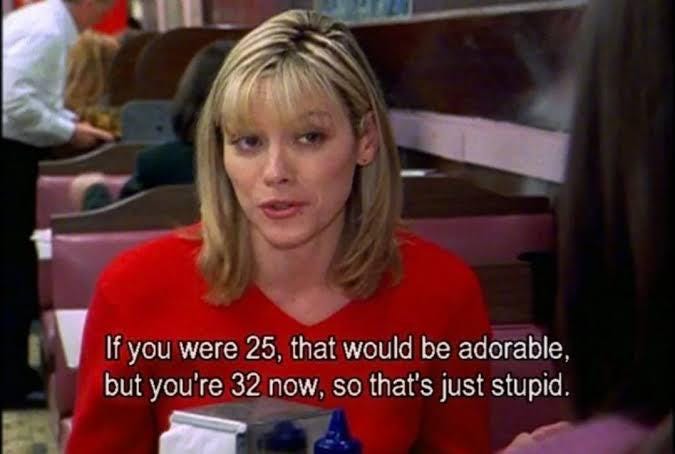
There’s a famous moment, initially shared by, of all people, Charlie Kirk, that is never far from my mind. Taken in 2019 at a campaign stop in Iowa, the video-turned-meme shows a Turning Point USA staffer approaching then-presidential candidate Joe Biden and pointedly asking the septuagenarian politician how many genders he thinks there are. “There are at least three,” he replies. When then pressed to “name them,” he snaps, “Don't play games with me, kid.”
So there’s “at least three” genders and so there’s at least three gender programs: “Girlhood,” “Boyhood,” and “Genderqueer” (i.e., media that questions this static, binary arrangement of identity). They say that behind every good man is a woman, so come meet the one in me:
The Queer Cinema Canon
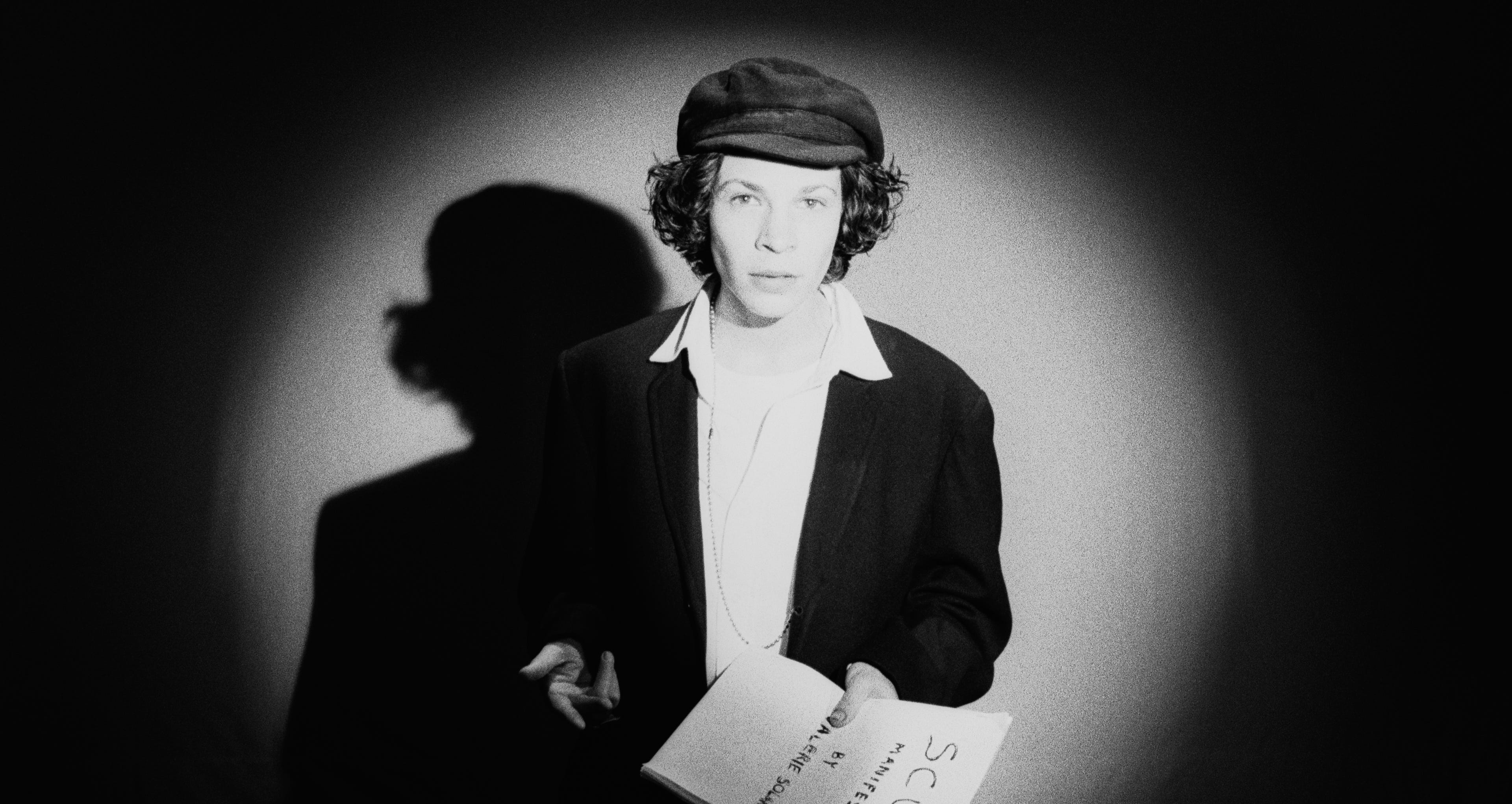
I actually have consumed some media other than basketball and heterosexual hell this past month: June is always lush with LGBTQ+ programming, and it’s been an embarrassment of riches that has only helped me bring even more films into our long-running Queer Cinema Canon. At IFC Center, we caught Janus Films’ beautiful 4K restoration of I Shot Andy Warhol (1996), the feature directorial debut of Mary Harron (American Psycho), which diligently recreates the scene at the Factory in mid-60s New York City in telling the story of Valerie Solanas, a radical queer feminist who shot Andy Warhol. Also at IFC: Maddie’s Secret (2026), the delightful “women’s TV picture” pastiche from comedian John Early, who masterfully performs the titular role in drag (I saw it twice). At Newfest Pride, I caught a peek at Gregg Araki’s outrageously fun BDSM comedy I Want Your Sex (2026), a return to form for Olivia Wilde and star-making turn for Cooper Hoffman, which opens July 31. There’s an interesting gay Australian horror movie, Leviticus (2026), playing at chain theaters. And at BAM, a selection of fascinating queer short films from the Film-Makers’ Cooperative, a vital repository for experimental work that helped to fight censorship laws in this country by first exhibiting Jack Smith’s queer classic Flaming Creatures (1963), which brought charges of obscenity against the co-operative and led to a high-profile court case.
Information on films like these and hundreds more, and how to watch them, are available in our latest Queer Cinema program on The Spread. Organized by year and divided by four eras (Pre-Stonewall, Post-Stonewall, “New Queer Cinema,” and “New Queer Classics”), the program features three categories of films: Essentials, Next Steps, and Deep Cuts. It’s a real labor of love and an honor to bring it back time and again, so take a peep and a chance on something new as we close out the month.
Sugar, Spice, and Everything Nice: The Construction of “Girlhood” Onscreen
“My chest isn’t big enough, my thighs are fat, my butt’s big, just normal girl things, you know?” opines a beautiful young woman in Wildwood, NJ (1994), an hour-long documentary about the titular beachfront town shot on Super 8 by an all-female crew, led by directors Ruth Leitman and Carol Weaks Cassidy. The forgotten film recently played at John Wilson’s Low Cinema, where I caught it with an appreciative crowd, instantly enamored by the subjects of the film, who are almost exclusively women. Captured on and around the boardwalk, the girls and women of the film are candid and charming while speaking on a variety of subjects, from boys to bodies to growing up and summering in Wildwood, all with a frank New Jersey candor and thick regional accent. Subjects range from 13-year olds to married women with kids, all celebrating the beach and its adjacent carnival delights; girls laugh, chase (and try to escape) amorous young men, tan, and drink. Occasionally, their faces flicker as they move on to tougher subjects—the “normal girl things” that linger like clouds on an otherwise perfect summer day. With its images of deceptively carefree young women with big hair carousing by the ocean, footage from Wildwood, NJ served as perfect fodder for the homemade music video Lana Del Rey put together for the original demo version of “Diet Mountain Dew,” a track later included on her debut album, Born to Die, the unofficial soundtrack to Cancer Season and the singer/songwriter’s thesis on Millennial pop girlhood (“A freshmen generation of degenerate beauty queens.”)
I’m always thinking about those “normal girl things”—what we take from girlhood, and what we reject of it, the damage it does, and the relief it provides for those who transition into it, later in life. There is no universal girlhood; no “divine feminine”; no essentialist reading of gender that will ever track for me. But there is still a concept of girlhood, shaped through our cultural texts, that has evolved with each generation—an unofficial guidebook of references, avatars, touchstones, and Biblical texts teaching “girls” how to perceive and present themselves; to understand their place in the world (and their place in proximity to men). Women wear strands of these collective nuggets like beads around their necks well into adulthood: some chip and fall off with age, some are torn off, and some persist, stubborn and solid.
Consider the babydoll dress, which, like ballet flats and kiddish culottes, are back in style with young women. The roll-out and styling of 23-year old Olivia Rodrigo’s fantastic new album you seem pretty sad for a girl so in love, with its punk incorporation of girlish silhouettes and Peter Pan collars, has sparked a wave of babydoll dress discourse, exemplifying anxieties around female adolescence in a post-Epstein world (a new kind of abstracted moral panic fueled by actual, real-life horrors perpetuated against underage victims). Under the harsh glare of this new (?) cultural lens, any perceived depiction of “girlhood” is inherently fraught, tied up in (and framed through) the perception and sexual peccadilloes of adult men. (That’s actually one of the earliest lessons of girlhood: your body is not your own). In Baby Doll (1956), a movie credited with codifying the “baby doll” nightie as babyish clothing, Carroll Baker plays a 19-year old former teen bride who wears the iconic bit of lingerie of the same name—invented during World War II as a way to conserve fabric—while sleeping in a baby crib, where she’s spied on by her lecherous, racist husband (Karl Malden), tasked with financially supporting her by her late father. In Jawbreaker (1999), a post-
“Kinderwhore” film with an ironic reclamation of 1950s silhouettes, teen queen Rose McGowan dons a babydoll nightie to a sleepover with her boyfriend, where she encourages him to fellate a popsicle for her own enjoyment. Two teen characters in the same garment, a potent cultural signifier, separated by forty years, but a world of difference.
Turns out, girlhood, as a social construct, is big thinkpiece fodder right now.
In a recent article for The Cut titled “Confessions of a Recovering Baby Woman,” Shannon Keating writes of the “I’m just a girl”1 phenomenon on social media and in popular culture, in which adult (usually white) women regress to some idealized state of helpless, girlish adolescence to cope with the structural issues that make adult life so difficult to bear. Rather than build political or social power, this regression to “girlhood” allows adult women to reinforce the systems of co-dependence that keep them disenfranchised from the potential gains of greater income and gender equality, all while upholding static ideas about womanhood as meek, subservient, and helpless. In this “baby woman” psychosis, the vagaries of existence—taxes, car maintenance, life planning—are delegated to a governing partner, who fills the role of guardian formerly occupied by a parent figure, keeping the woman in a Miss Havisham-like state of permanent arrested development. Girlhood, more than a definite period of adolescence, lost forever, is like a mode we can tap back into whenever the going gets tough: a sort of costume, or performance, of definite gendered traits that help us get what we want and absolve us of personal responsibility. And white girlhood—with its cultural assignation as some sort of eternal precocious innocence—holds a certain privileged power, which extends white adult women a lot of grace, long past the point they maybe deserve it.
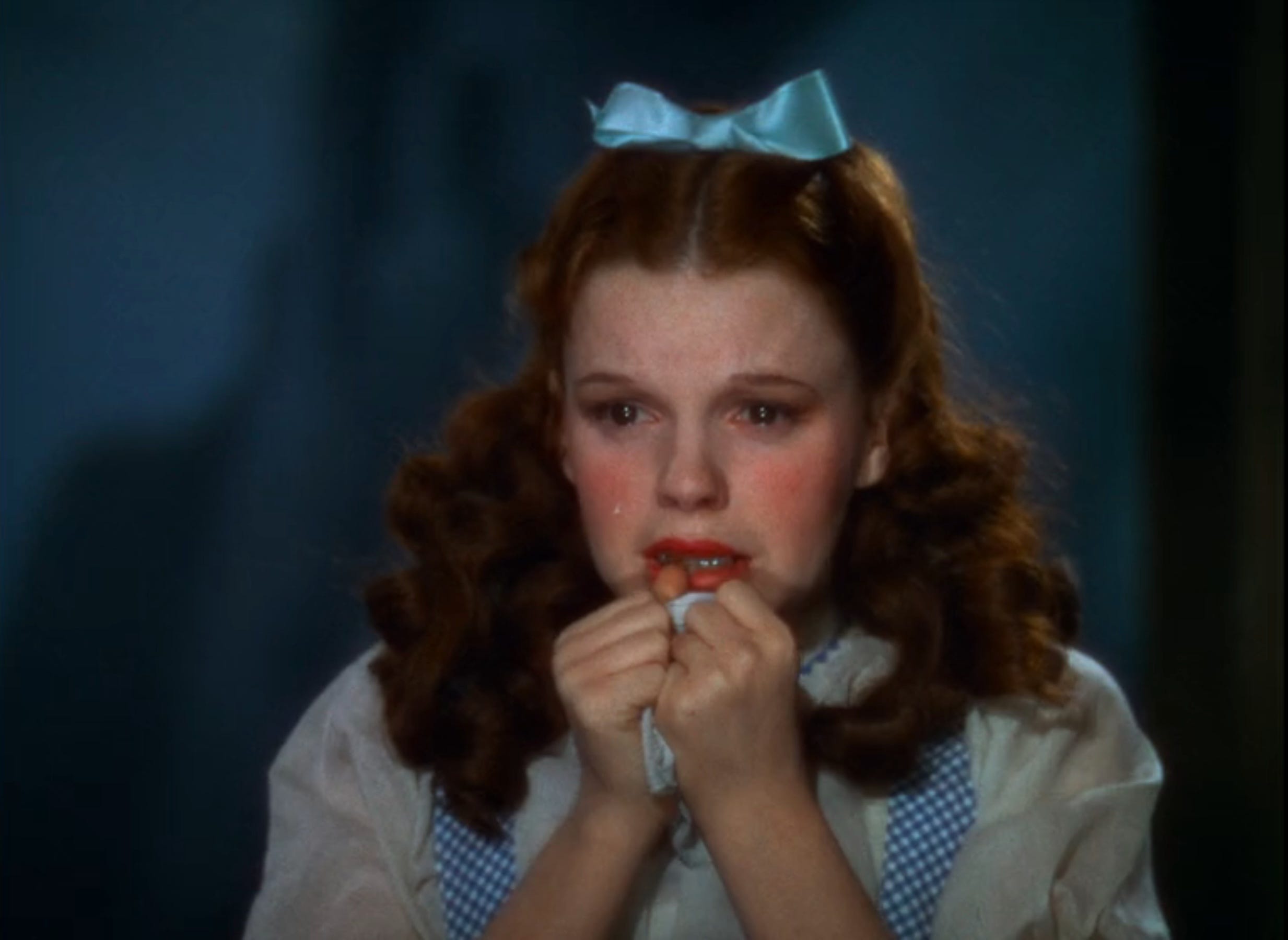
I was born in the 90s, in the shadow of Third-wave feminism: Roe vs. Wade and Title IX were enshrined by law, and girls could do anything, ostensibly, that boys could do. But they were different creatures: distinct and binary, tethered to biological realities observed and enforced before frontal cognition. Thrust into this essentialized world, I fell in love with ultra-femininity from the moment a Barbie doll was placed in my young, impressionable hands, and I felt the smooth, surreal curves of her plastic, perfect body. From that moment, femininity was something so lovely to observe, but always externalized, so unattainable no matter how many butterfly clips I put in my hair and fluorescent glitter I smeared across my body; the beautiful object was never me. With this sheer love of beautiful things, and with a body that curved near-cartoonishly beginning in my teens, there was never a possibility, in my mind, that I could be anything but a girl. And with Cinderella ballgowns, ruby slippers, “Baby Spice,” Sailor Moon, Anne of Green Gables, tea parties, Britney Spears, the Olsen Twins, Destiny’s Child, the Powerpuff Girls, Kit Kittredge—and later, Meg Cabot, Debbie Harry, Skins (2007 – 2013), Bikini Kill, Dirty Dancing (1987), Martha Coolidge, Cyndi Lauper, the Bronte sisters, and Diablo Cody—to pacify me, there didn’t seem to be any reason to question it, even as I sometimes dreamed of playing football and having a flat chest and being a Teenage Mutant Ninja Turtle. This is how I came to be an observer of, and somewhat reluctant participant in, the world around me. These are the things that helped me do it.
These are the cultural texts that help shape and inform, as well as interrogate, “girlhood,” from Shirley Temple, Haley Mills, Debbie Reynolds, Sandra Dee, Molly Ringwald, Sanaa Lathan, and Lindsay Lohan; to Go Ask Alice (1974), The Baby-Sitters Club (1995), Speak (2004), and Are You There God? It’s Me, Margaret. (2023); to The Facts of Life (1979 – 1988), Square Pegs (1982), and Clarissa Explains It All (1991 – 1994); to Alice in Wonderland, Little Orphan Annie, Heidi, Laura Palmer, and Bella Swan; to My So-Called Life (1994), Sister, Sister (1994 – 1999), Buffy the Vampire Slayer (1997 – 2003), and Pretty Little Liars (2010 – 2017); to the Heathers, the Plastics, and the Cheetah Girls. With this program, I made a conscious effort to include diverse perspectives—across race, class, ethnicity, and sexuality—and to be inclusive of our trans sisters’ stories, complicating our understanding of one universal “girlhood.” It can’t be comprehensive, but at 182 works, I like to think it’s pretty damn close!
Screw You Guys, I’m Going Home: The Construction of “Boyhood” Onscreen
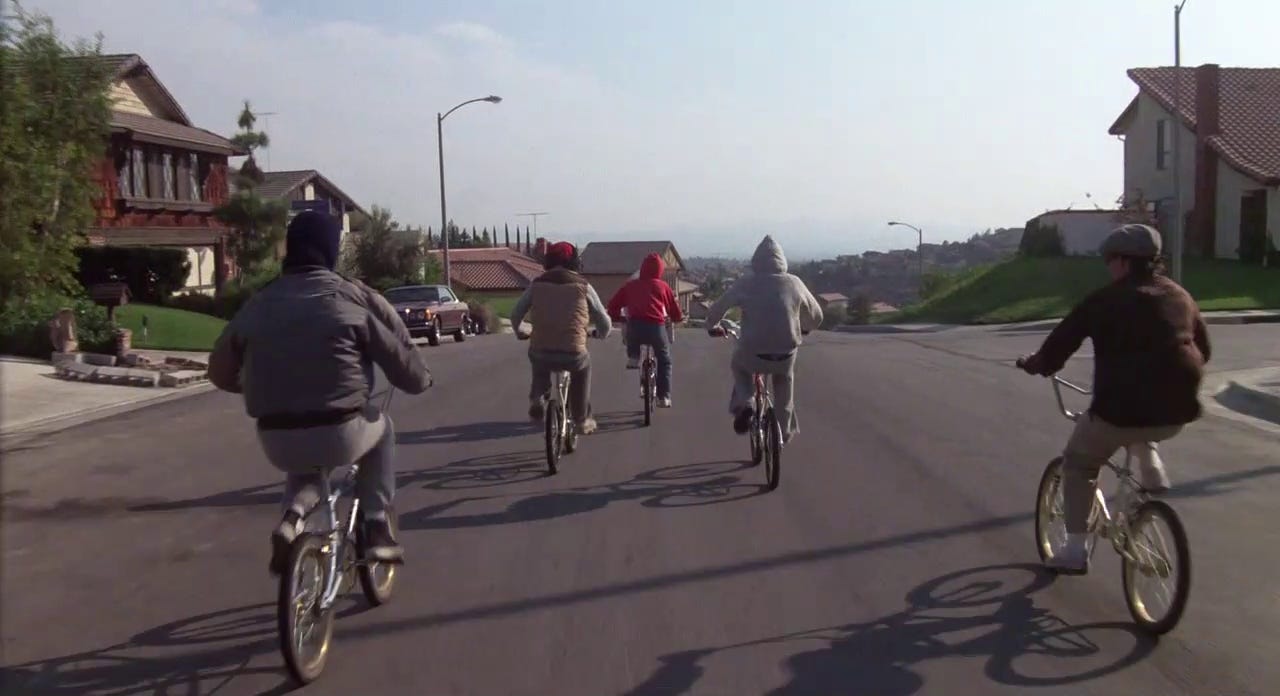
This July, Boyhood (2014) Richard Linklater’s Best Picture-winning coming-of-age story about the son he never had (he has three daughters), returns to theaters for its 12th anniversary in honor of the twelve years the filmmaker spent shooting the picture. Following the same actor (Ellar Coltrane) as he ages before our eyes (alongside Linklater’s real-life daughter Lorelai, who plays his sister), the film is a loving document of Texas aughts boyhood, which I took somewhat personally. After all, it’s sort of my story too, with eerie echoes (and serious deviations) from my own childhood: Boyhood understands that parental absence is as determinative as presence, with popular culture filling in the gaps and lapses for young minds looking for self-determination. In Boyhood, the siblings attend a midnight release of Harry Potter and the Goblet of Fire (2000), which was the fourth novel in a popular children’s series written by some loser and the first in the series to be released simultaneously in the U.K. and United States, making it a major cultural event (both in real-life and in the movie itself). In the novels (and hit film series), Harry Potter is a poor, abused young boy who is told he is actually in possession of a great gift, and a messianic story that makes him the only one capable of defeating a great evil. Like Star Wars (1977) before it (and its smarter progenitor, Frank Herbert’s Dune), coming-of-age as a young man means shrugging off the ordinary boy you’ve been and accepting your great destiny, harnessing your powers towards true greatness. When we meet Goku, son of Gohan, in Dragon Ball Z (1989 – 1996), the hit, formative anime sequel series that once played in heavy rotation on Cartoon Network’s “Toonami” block, he’s weak and pathetic, in contrast to the powerful, disciplined man his father has become. A self-insert for young male viewers, Gohan undergoes a metamorphosis through rigorous training, self-actualizing with “Super Saiyan” power-ups that ultimately help him escape his father’s shadow.
“Boyhood” onscreen, unlike “girlhood,” is less generally a study of (and preoccupation with) aesthetics, and more an examination of recognizable motifs: power, courage, anger, strength, resilience, tenacity, indifference, intelligence, bravery, hate, responsibility, and (sometimes) sensitivity. Men are saviors and scourges: adolescence is the testing ground for which path they’ll take towards power, and many depictions of that period are cautionary tales about its perils. In Lord of the Flies (1963), the lauded adaptation of William Golding’s classic 1945 British novel, popular with grade school curriculums (which usually divorce it from its gendered specificity), young men, left to their own devices, tear each other apart—it’s in their inner-most nature. In A Clockwork Orange (1971), Stanley Kubrick’s iconic take on Anthony Burgess’ infamous novel about English youth subculture in a dystopian future, gangs of teenagers roam wild in the streets, raping, assaulting, pillaging and terrorizing masses simply because they can, and it feels good to do so; the government, in turn, tries to forcibly correct this normalized sociopathy through aversion therapy exposure to violent audiovisual imagery. This preoccupation with saving young men from their own sociopathy (or at least understanding its provenance) pervades contemporary media, from the forceful ennui of James Dean in Rebel Without a Cause (1955) to the boredom-fueled crime sprees of middle-class kids in the planned community of Over the Edge (1979), to the teen snuff-film enthusiast of Michael Haneke’s Benny’s Video (1992), to Edward Furlong’s white-supremacist descent, fueled by bad actors, in American History X (1998), to the Columbine-inspired shooters of Gus Van Sant’s Elephant (2003), who are galvanized by violent media, to the murderous 13-year old of recent “water cooler” show Adolescence (2025), who is radicalized by “Manosphere”-adjacent streaming content.
With great power comes great responsibility. Movies like the Karate Kid (1984) and Vision Quest (1985) focus on the ways in which body training strengthens the mind, and character, against tough bullies/foes, on the path to masculinity. In Hoop Dreams (1994) and Friday Night Lights (2006 – 2011), athletic prowess in the world of high school sports are a path out of socioeconomic disenfranchisement for young kids of color, often with the weight of their whole families on their backs. In teen sports melodramas like Hoosiers (1986) and Remember the Titans (2000), the dreams and needs of a whole community are dependent on the athletic discipline of a few great men. And in Varsity Blues (1999), a young man’s self-actualization stems from stepping away from his father’s displaced dreams of athletic glory, with the young man choosing an academic pursuit over football prowess (“I don’t want your life!”).
Not all stories of male adolescence focus on the wielding of power: some are about the inherent neutrality of their lives, in coming-of-age “hangout” stories, like George Lucas’ 50s pastiche American Graffiti (1973), and Richard Linklater’s 70s pastiche Dazed and Confused (1993), which was directly inspired by it.2 But most tell the story of personhood forcibly molded by the vagaries and trials of life, and the way he responds to that onslaught, like the forging of a great weapon. This sense of personal ethos is typically not something that comes naturally, but is bestowed on him by his relation to other people. And, not always people! Actually, the most pervasive motif in literature and film aimed at young men is that of the devoted pet/animal, a tool with which to teach young men empathy and/or responsibility: a sampling of films from this program include Old Yeller (1957); Kes (1969); Sounder (1972); Where the Red Fern Grows (1974); The Fox and the Hound (1981), in which they’re also the animals; Free Willy (1993); Shiloh (1996); Flipper (1996); and My Dog Skip (2000). It’s as if men cannot understand the sanctity of life without being given something truly innocent worth protecting (something that, incidentally, cannot talk back, and challenge their inherent authority).
The best media in this program treat their male characters with relative nuance, focusing on the ways masculinity can mean many things beyond brute strength (and restraint). Vincente Minnelli’s Tea and Sympathy (1956) is an underrated melodrama excoriating the toxic masculine codes of conduct enshrined in homosocial spaces, which have a lasting negative impact on adult men. Francis Ford Coppola’s The Outsiders (1983), and its less-seen sister film, Rumble Fish (1983), adapt the writing of young adult novelist S.E. Hinton, depicting the fraternal bonds between young men, informed as much by love and care as the physical violence of their teen gang lifestyle. The late Rob Reiner’s Stand by Me (1986), the lodestar of the program, is a film about young masculinity that is very important to me, personally. A sensitive, beautifully-performed tale of four friends who carouse and mock each other on a pivotal summer excursion before a divergent event (the start of high school), I saw myself in the nebbish, moody hero (Wil Wheaton), who takes solace in these bonds, even as he’s constrained by 50s codes of masculinity from over-sharing his precarious emotional state. His best friend (River Phoenix) draws it out of him nonetheless, providing an emotionally-intelligent counterweight to his cold, unfeeling father, who resents him for his athletic older brother’s premature death. Maybe it’s because I saw myself and my equally emotionally-constipated best friends act similarly to these young men, doling out love and support in-between a protective patter of ironic insults and Cartman impressions,3 which belie real sadness and struggles, subsumed for the sake of survival. Stand By Me (1986) directly inspired John Singleton’s Boyz n the Hood (1991), a “hood classic” coming-of-age story that upended our assumptions of universal boyhood by telling a story of young, complicated men set far beyond the lens of white Americana. These films join similar complicating portraits of young masculine life, and the love and compassion that’s throttled and de-prioritized, but not absent, in young men, like Dead Poets Society (1989), My Own Private Idaho (1991), Billy Elliot (2000), This is England (2006), Superbad (2007), 20th Century Women (2016), Good Boys (2019), C’mon C’mon (2021), and 28 Years Later (2025).
These are the cultural texts that help shape and inform, as well as interrogate, “boyhood,” from the Little Rascals to Beavis and Butt-Head to the WWE; to Sean Astin, James Van Der Beek, and Leonardo DiCaprio; to The Fresh Prince of Bel-Air (1990 – 1996), The Adventures of Pete & Pete (1989 – 1996), and Boy Meets World (1993 – 2000; to Ferris Bueller to The Monkees to Huck Finn (and Tom Sawyer); to Teen Wolf(s), Cameron Crowe, Bill and Ted, and the many films of Penelope Spheeris, Dude Whisperer. As with our girlhood section, I made a conscious effort to include a diverse cross-section of media—spanning race, class, ethnicity, and sexuality—as well as transmen coming-of-age stories, intended to diversify our understanding of one universal “boyhood.” This one only stretches to 178 works, so I guess the girl in me technically won.
Histories, like Ancient Ruins, Are the Fictions of Empires: Genderqueer Representation
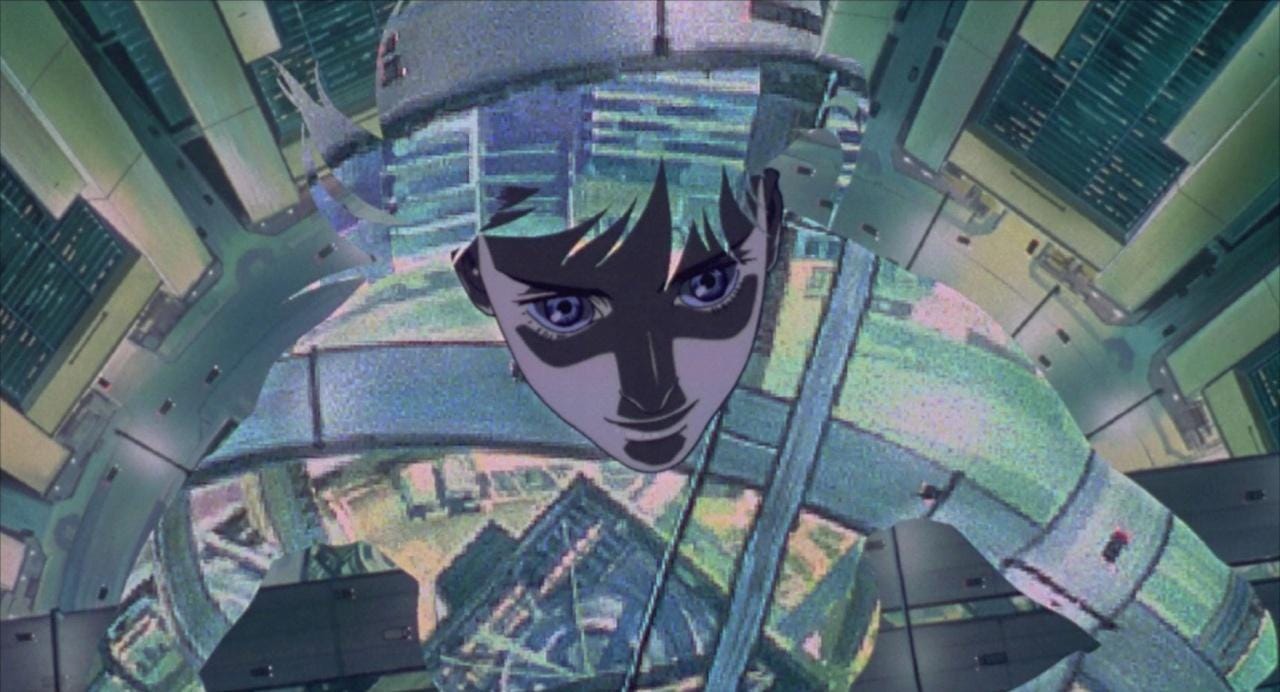
“When I was a kid, I took my shirt off, imagining I was just as sexy and as powerful as when Matt Dillon did it for the centerfold of Teen Beat magazine,” Sadie Benning, holding the photo in question up to their own face, narrates in Girlpower (1992), the non-binary filmmaker’s riot grrrl-inspired short film, part of a series of videos the artist (and Le Tigre founding member) filmed on Fisher-Price’s lo-fi Pixelvision camera as a teenager. “...And when I sang, I became every member of the Go-Gos, Blondie, Joan Jett, Devo; I did it all.” Benning’s work, including their hard-to-find narrative feature, Flat is Beautiful (1998), is some of the earliest self-reflexive storytelling exploring non-binary adolescent identity: they began making movies on Pixelvision as a child, long before a definite label on that identity was known to an outside world.
Laid out in such evocative, plain language, it seems like a pretty simple concept, but it’s still somehow not so easily understood by many: not everyone fits so neatly into the two categories we’ve organized our entire society around.
“What do you think you are?” a young woman pointedly asks Gaish, a young non-binary host and subject of Shinjuku Boys (1995), a groundbreaking documentary about Japanese transmasc life in the “onabe” nightclub scene of Tokyo. “I don’t think I’m anything,” they reply. “I’m just me. I’m not bothered about it: I don’t think I’m a girl and I don’t think I’m a boy. If people say I’m in-between, that’s OK…This is how I’ve always been, so it seems natural.”
I knew when I put together programs on the media construction of “girlhood” and “boyhood” that I wanted to also attempt a third program of films that explored adolescent gender identities beyond the established binary, which I’m including under the umbrella term “genderqueer.” Meaning: agender, bigender, androgyny, genderfluid, Two-Spirit… simply put, any young person that considers themselves outside the scope of “girlhood” and “boyhood.” Obviously, from a programming perspective, that’s a much more difficult task, given how new these labels are in the cultural lexicon, and how these labels are often fluid themselves (or in older media, tethered to outdated ideas about gender and sexuality). But that’s really why I wanted to push myself to do it. The cultural repositioning of gender as something that is subject to interpretation by the individual, burdened by the act of performance, and independent of biological determinism is incredibly new, but needs to be normalized, especially as trans and gender non-conforming folks are subject to increased scrutiny, harassment, and discrimination from several arenas—most notably, the federal government, which announced in January 2025 that it only recognizes two genders, redefined as “sexes,” aligned with assignations at birth. This has had a catastrophic effect on the lives of trans, intersex, and non-binary individuals, despite a pending court challenge, affecting everything from government-issued IDs to healthcare access to prison placement. But on an existential level, it also threatens to rewrite all that we’ve learned about gender as a society in recent years beyond its simple medical designation. If you go to the page for “Two-Spirit” on the website for the Indian Health Service, the federal health program for American Indians and Alaska Natives, for example, you are now greeted with the following banner:
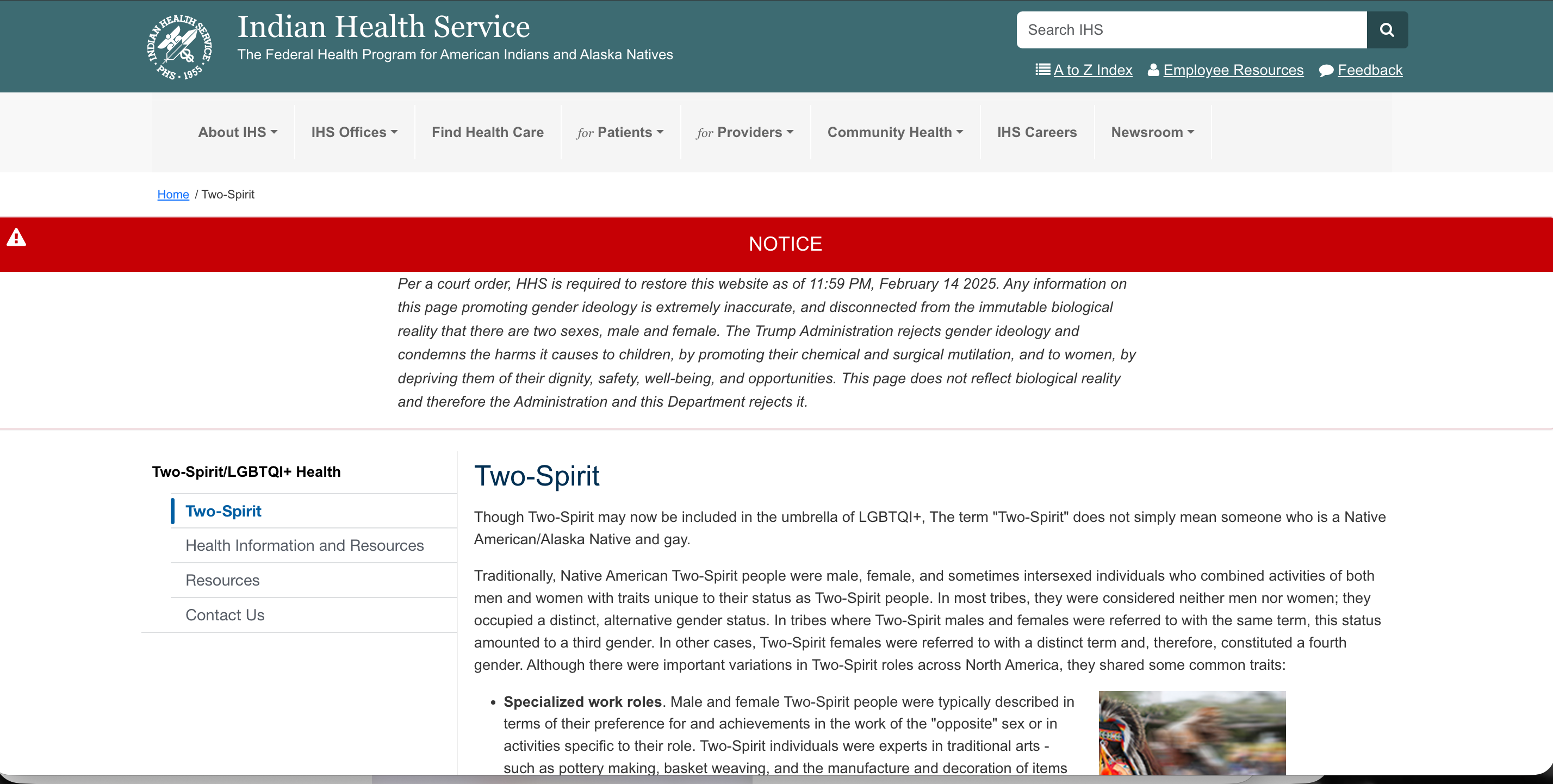
In other words, as much as we take for granted how much the world has changed, all of the perceived social gains of the 2010s and 2020s are mutable, subject to structural and historical revisionism by bigots in power—and all people who fail to live up to some imaginary, idealized notion of gender are similarly up for scrutiny under such arbitrary standards of gender. In a world under attack by those burdened with limited imaginations, art is, and remains, a refuge: as long as individuals have the means to tell their stories, genderqueer identities will always find an outlet (simply because genderqueer people, and thus genderqueer artists, will always exist). And art that tells stories of genderqueer adolescent identity—or inspires identity exploration through obvious allegorical stories—helps children feel less alone. It saves lives.
In my close-minded era, children’s identities were policed without our even knowing it—who knows what might have been possible for certain people if the cultural landscape had looked different? Every generation thinks like this, but Millennials are both close and far enough from these seismic cultural shifts, brought about by organization and education made possible by the internet, to feel unmoored by it. Nowadays, my friends who are parents have books like Megan Madison and Jessica Ralli’s Being You: A First Conversation About Gender, which teach and prioritize self-identification in young children, gifting them a truly tremendous power. Shows for kids like The Owl House (2020 – 2023) and She-Ra and the Princesses of Power (2018 – 2020) have non-binary characters; Academy Award-nominated animated film Nimona (2022) serves a parable about non-binary identity from a non-binary creative; and Matrix Resurrections (2021), Lana Wachowski’s recent Matrix sequel, conjures up a new generation of futuristic humans influenced by the world (/film) of The Matrix (1999), and its central trans allegory, to which a spectrum of gender identities now seems possible. Finally, the buzziest film out of the Cannes Film Festival last month, Teenage Sex and Death at Camp Miasma (2026), comes courtesy transfeminine non-binary filmmaker Jane Schonenbrun, whose previous teen-oriented films We’re All Going to the World’s Fair (2021) and I Saw the TV Glow (2024) are parables for transgender / non-conforming viewers “in the know.” It’s a beautiful bit of progress, amidst so much ugliness.
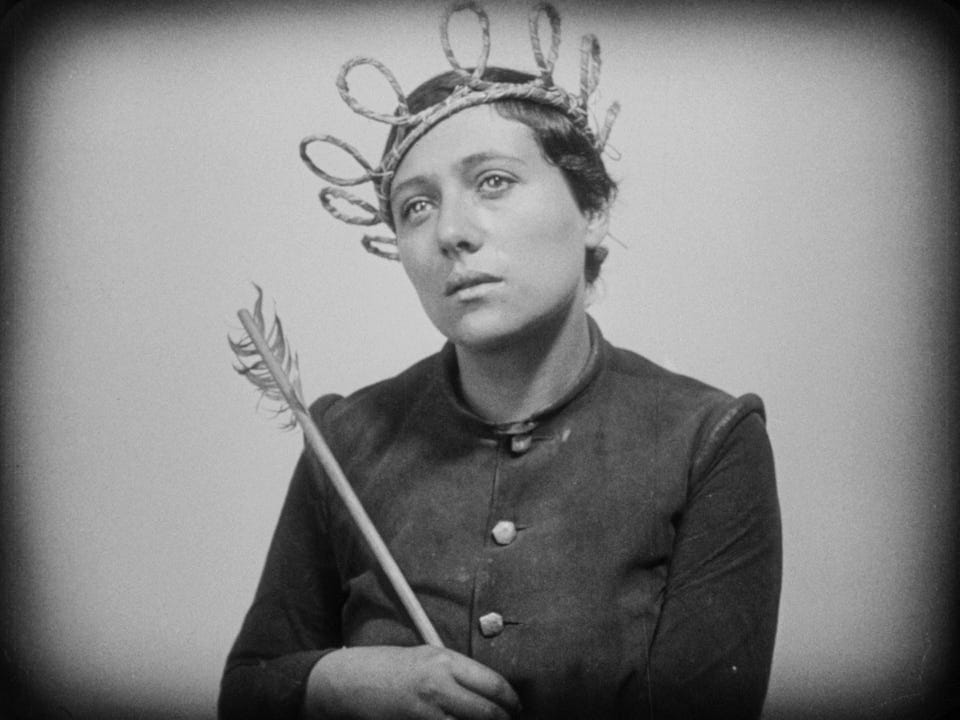
This program collects an eclectic mix of films both about non-binary / intersex adolescents and gender non-conforming-coded stories/characters, including the beautiful androgyny of Renée Jeanne Falconetti in Carl Theodor Dreyer’s The Passion of Joan of Arc (1928), so championed by “gender outlaw” / activist Leslie Feinberg in Alisa Lebow’s Outlaw (1994). Plus: Don Mancini’s seriously ahead-of-its time Child’s Play sequel, Seed of Chucky (2004), in which Lord of the Ring’s Billy Boyd voices Chucky’s genderfluid child (never forget that Chucky is canonically an ally!); androids-as-allegories; the complicated, groundbreaking legacy of SNL movie It’s Pat (1994); Sally Potter’s Orlando (1992), itself a tribute to Virginia Woolf’s one-time partner, genderqueer author Vita Sackville-West; Velvet Goldmine (1998), with its radical presentation of alternative, secret history told through queer art; and the fascinating, ambiguous gender performances in Farewell my Concubine (1993) and Mulan (1998). These movies queer our understanding of a baseline adolescent identity, tethered to external labels, in favor of self-determination, the ultimate form of liberation. “A freedom you can allow yourself…or not.”
I’ll leave you with one last genderqueer text, which is particularly near to my heart. In Ranma ½ (1989 – 1992), a classic anime series adapted from Rumiko Takahashi’s manga of the same, a teenage martial artist named Ranma discovers that, following exposure to an ancient Chinese curse, he is forcibly transformed into a girl when splashed by cold water; when struck by warm water, he reverts back into a boy. The first time I watched it, sometime far too late into my 20s, my TV, as the kids say, started glowing. Honestly, if I were to try and explain how I personally view my gender presentation, it would be “some kind of Ranma ½ situation”: a sort of gender randomizer, switching between male and female at random, acting as an independent mechanism far beyond my control. But, you know, try explaining that, in those exact words, to your therapist.
That’s all for June! We’ll be back in July for more original streaming programming. Until then, what is good enough for you is good enough for me!
For what it’s worth, I do think the “I’m just a girl” phenomenon is mostly intended to be ironic, and not prescriptive. Like so many things online today, it seems like Gen-Z humor that is being co-opted by Millennials, who do actually need to do things like file their own taxes, because they are adults, and know better. And I maintain the controversial opinion that Millennials should not be on TikTok, where they’re liable to encounter such things.
Young women are in both movies, but they’re decentralized—infamously, the epilogue of American Graffiti reveals none of the fates of its female characters, which pissed off Pauline Kael.
Lore drop: there was actually an extended, weird period of time when my best friend and I would communicate almost exclusively to each other in variations on the “Cartman” voice. A show that understands that childhood male friend groups often follow a spectrum of personalities, many of whom don’t get along, or even like each other (sometimes being best friends is just growing up in the same shitty town and trying to fill the days), South Park (1997 – present) was deeply formative to adolescent male personalities (and humor) in the 2000s, but it had a big impact on me too, which probably explains whatever gender thing is going on with me. I can only liken my consumption of South Park to the way the young protagonists consume the fictional show at the heart of Jane Schoenbrun’s I Saw the TV Glow (2024)—which is to say, not in a way that is particularly well-adjusted. After watching the infamous “crab people” episode at a childhood friend’s house and finding it to be the height of hilarity, I consumed every episode I could find on cable and late night network syndication, bought season DVDs and listened to their audio commentaries, perused message boards, and even printed out physical scripts from my favorite episodes—a hyperfixation, in other words, that shaped my entire personality. Everyone has a story!